NEWS COVERAGE 2002
Posted on: Thursday, July 11, 2002
Hundreds lured back to Pepe'ekeo
By Hugh Clark
Advertiser Big Island Bureau
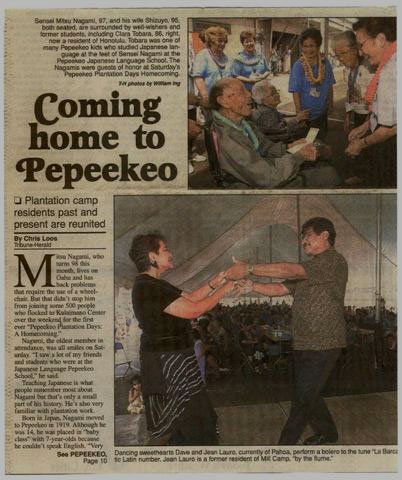
PEPE'EKEO, Hawai'i — Two years ago, Caroline Ducosin of O'ahu shared on the Internet her warm recollections of childhood in the small plantation town of Pepe'ekeo, stirring similar memories among former residents around the world.
The high-tech connection led to this weekend's town
reunion, when 400 visitors and longtime residents are
expected to celebrate what life was like in a very
low-tech era.
Reunion organizers Jodi Endo Chai and Judi Obra
Parker said the children used to invent simple games
such as blocks, which resembled hopscotch, and
another called klang-klang in which kids pushed
around an empty Carnation milk can with a rock inside.
*Parker also remembers when the first family in town got electricity. They were chosen for the honor because of an upcoming wedding. Everyone else had to make do with kerosene lanterns until the entire village was hooked up.
Pepe'ekeo, just eight miles north of Hilo, was the site of a sugar plantation for
123 years. Among the company owners was Chinese investor Chun Afong,
Hawai'i's only Asian plantation owner in the last century and the subject of
the book "Merchant Prince of the Sandalwood Mountains," by Bob Dye (University of Hawai'i Press, 1997).
When the plantation shut down nearly a decade ago, Pepe'ekeo already was in
decline.
Its school had closed 30 years earlier, and children continue to be bused four
miles south to Kalaniana'ole School in Papa'ikou.
The 2000 census placed the population at 1,697 — 116 fewer residents than
in 1990.
A credit union has hung on. You can also find a post office, a general store,
and a power plant that now burns coal instead of bagasse, a by-product of
cane processing that is no longer available.
Kula'imano, on the mauka side of the Hawai'i Belt Road, became a major retirement center as C. Brewer closed several camps, consolidating them into a residential community built with federal assistance and the leadership of retire county housing figure Megumi Kon.
This weekend's reunion will be held at the recreation center at Kula'imano.
Parker said the focus of the event is not so much on the history of the town as
what it was like growing up in a multiethnic plantation community.
"We had maybe one car for every 10 families," she said, so arrangements were made to make sure everyone got to Hilo for shopping and medical
appointments. "We all pitched in."
In its heyday, Pepe'ekeo was a hotbed for baseball, the pre-statehood labor
movement and politics.
Many former residents wound up as major newsmakers in Honolulu, including former sports star and past state Senate President Norman Mizuguchi; Russell Ogata, head of the Hawai'i Government Employees Association; and Eusebio "Bobo" Lapenia Jr., state leader of the International Longshore and Warehouse Union, who still commutes from his hometown to his office in Honolulu.
A gathering with pupu will be held at 4 p.m. tomorrow, with the main reunion event at 11 a.m. Saturday. Sunday has been reserved for a golf tournament and smaller family gatherings.
For more information, call Rosita Cabatu at (808) 964-1796.
*correction to Mr. Clark's article: A Pepeekeo resident shared the memory with
Parker of when the first family in town got electricity.
Hawaii Tribune Herald
Hawaii Tribune Herald
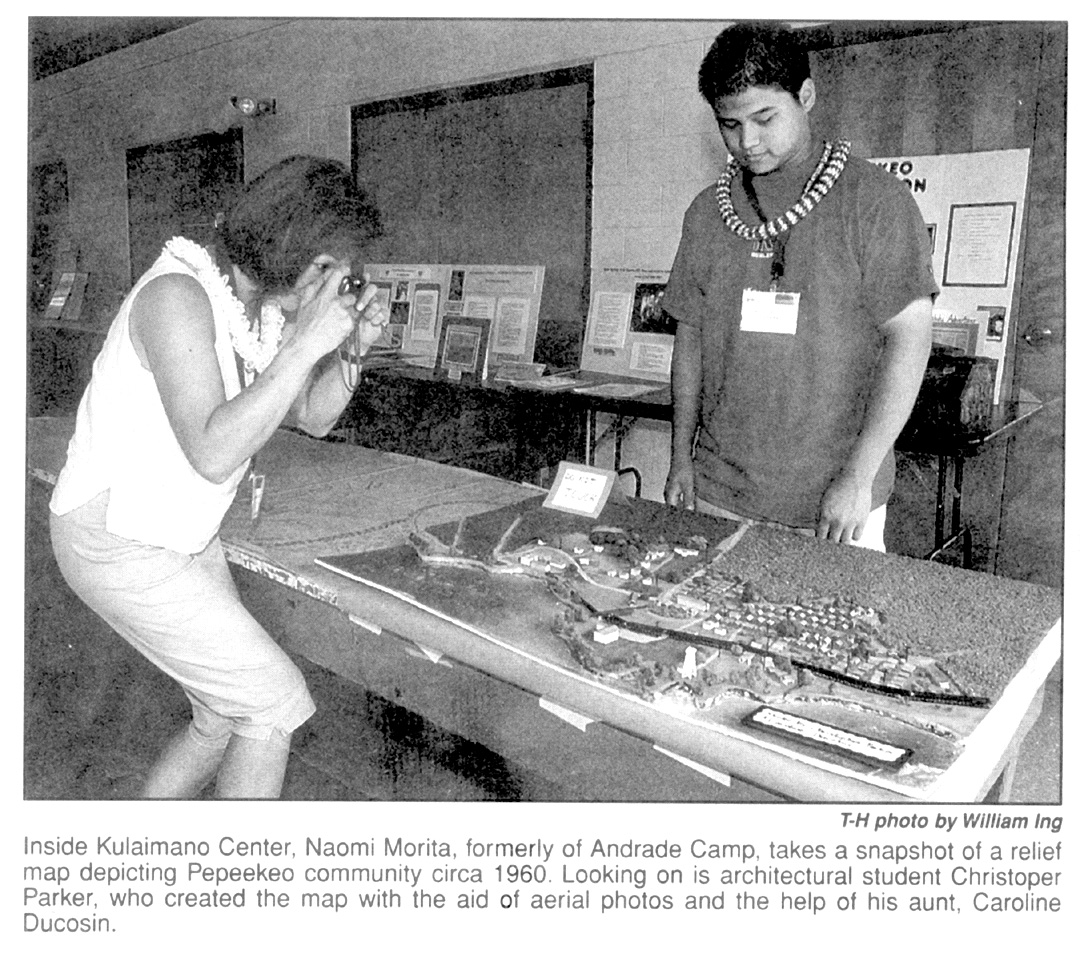
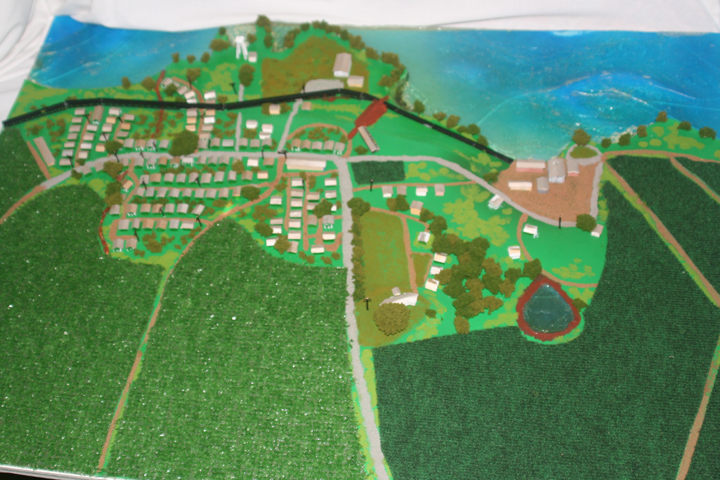
Pepeekeo Mill Camp created by Chris Parker with the help of his Aunt Caroline Ducosin